Here's the first page of an article looking at how we figure out what's in those "toxic assets" which everyone wants to throw into a "bad bank."
* * *
Introduction - We're not moving fast enough.
While there has been much handwringing by financial market observers, regulators, elected officials and others as our banking industry sways back and forth on the edge of a precipice, it appears that there is little understanding (but much fear) of the magnitude of the collapse of the credit markets on our banks and other financial institutions, and exactly where, and with whom, the problem lies. The consensus is that the collapse of the subprime mortgage market was a major cause of the current crisis. Asset-backed securities (ABS) and securitized assets created from the subprime mortgages originated in the now collapsed housing market make up the bulk of the so-called “toxic assets” now found in the portfolios of troubled banks. By identifying these assets and their owners, and establishing values (or a lack thereof) for them, the federal government and others will be better able to make informed judgments about what to do next, whether to absorb the assets of these institutions, or recapitalize those banks that need it.
Identifying the assets and establishing values for them is not an impossible task. There are threads to untangle, relationships to understand, and documents to review, all of which in the end will help us answer the question “how much?” But time is of the essence.
Make no mistake, this is a mess. The securitization market is complex, and was made more so as it burgeoned throughout 2006 and 2007. There are no central sources of unbiased, normalized information. Further, the picture of those who participated in this market is a moving target. The financial services industry has evolved faster in this decade than ever before, by any consensus description shared among knowledgeable participants, and new sub-sectors are emerging annually. The evolution of sub-prime mortgage origination mechanisms was only one of those feeding the explosion in types and volumes of derivative instruments. Importantly, it was also one at the center of the least regulated (and, hence, least documented) growth areas for structured financial instruments. Many of the originators of subprime loans are no longer in business; many of the institutions that bought and sold these products are no longer, or have been bought up or split up. Individuals who sold or structured the deals have disappeared. Put simply, the landscape has radically changed since the market exploded in 2006.
To unwind these securities, one must go back in time to re-create connections and transactions. Hindsight in this case is not likely to be flattering, but an accurate postmortem is critical if we are to learn from our mistakes. We are living through a significant, if not the most significant ever, credit crisis. This is not the first time, however, that markets have shown themselves to be inherently unstable in a given set of circumstances. Fortunately, we are living in a time where history itself is changing – we have audit trails and methods for deducing and analyzing recent past transactions and relationships that did not exist in prior crises.
There are three layers to understand as we begin the process of dissecting the asset-backed security/securitization market:
• The Participants – Sources of Investment Capital, Intermediaries, or Product Providers, those operating in and around what we call the “Trading Zone”
• The Instruments – Securitized assets, including their valuation components, and
• The Relationships between the Participants and the Instruments.
....
Monday, February 2, 2009


Wednesday, January 28, 2009
La Grève Nationale
What a country! Tomorrow, most of France will be on strike. Trains, buses, and national air flights, will all be on "strike" schedules, even school teachers are participating. The unions for all these services have banded together for this national gripe day. The papers and news services have spent most of today making sure that everyone knows it's coming. Sarkozy tried to ameliorate the effects of this type of thing on students last year, passing a "minimum" state of staffing that schools are supposed to maintain during a strike (so that parents can actually go to work, if they need to). But the news is reporting that most schools are telling parents that there will be no teachers at school tomorrow.
Why are they striking? Because they don't think they are being paid enough, or at least as much as President Sarkozy promised they would. The unified "national" strike is fairly unusual, but according to a poll, 75% of those asked said they thought that the day-long strike was "justified." The local paper here, Nice-Matin, questioned whether or not such a strike made sense in a time of financial crisis. Apparently, according to the French populace, the answer is yes.
I think I will go down to Place Massena tomorrow morning at 10 a.m. and check out the Niçoise unions as they participate in this truly French tradition. Vive la France!
Why are they striking? Because they don't think they are being paid enough, or at least as much as President Sarkozy promised they would. The unified "national" strike is fairly unusual, but according to a poll, 75% of those asked said they thought that the day-long strike was "justified." The local paper here, Nice-Matin, questioned whether or not such a strike made sense in a time of financial crisis. Apparently, according to the French populace, the answer is yes.
I think I will go down to Place Massena tomorrow morning at 10 a.m. and check out the Niçoise unions as they participate in this truly French tradition. Vive la France!
Tuesday, January 27, 2009
Happy Chinese New Year!
Happy Chinese New Year, readers! I feel like I should check in with you all, although my mind is a bit full of asset-backed securities, tour planning, and wondering why Citibank was even THINKING of buying a $50 million dollar luxury jet. I mean, really!
As President Obama has been living his first 100 days - gosh it's hard to buck history, huh? President Roosevelt started it and now no one will let the President shake this designated introductory time period -- I have been starting my own 100 days. As I said I would (even as early as last May!), I started a job search this month. I decided to start my search by looking here in Europe. I would love to extend my time here in a wage-earning capacity. This is not a slam dunk, however, for a few reasons. One, the economy. There is a big recession going down here in Europe, too. Two, my lack of a work visa. The European Union is pretty high on giving its own jobs, so a company would have to go to the mat, as it were, to hire me (they would have to assert that there is no other European out there that fits the job as well as me - well, of course it would be true!). Third, my language skills. I am fluent in English, have conversational skills in French. That's pretty limiting for looking for a job in Europe. My efforts have to be focused in places where I might have a fighting chance - at the moment, that looks like London, Monaco, Zurich, and, perhaps, Paris. But, hey, I have Wharton classmates all through Europe, unknown contacts that may pop up here and there, you know, by just starting a conversation. And then, of course, there is the Internet.
If you have any ideas of people/companies for me to talk to, send them along! My resume is certainly available for review.
I have said that if my job search here doesn't produce anything by the summer, I will frolic here in the Cote d'Azur for a few more months before heading back to the States and job hunting there, with the hopes that by the third quarter of 2009, the job situation has started to improve.
My calendar is already starting to fill up with visits from friends, but here are a few great reasons to visit the south of France in the months ahead:
February - Carnaval. Two weeks of parades and amusements leading up to Mardi Gras, this year on February 24th.
May - The Formula Grand Prix in Monaco.
July - The Tour de France. This year the race begins in Monaco, on July 4th. On July 5th, the race starts in Monaco and goes through Nice on its way to Brignoles, along the coast.
And then all the other festivals around the Cote d'Azur in between. The weather starts to get nice in February - I'm told winter is almost over here - so it just gets better from here on out. My parents will be here for Carnaval; you can look forward to photos and descriptions of the over 125-year-old event event in Nice at the end of next month.
My absorption in asset-backed securities this week was related to the drafting of an article with my friend in Washington that will give an outline for how to begin valuing the subprime market, now that it's considered valueless. Most people have thrown up their hands at the whole mess, but we have an opinion of how to really get at the bottom of the heap and start figuring it out. I'll post the article here when it's closer to done. It's got some nice pictures for those who like visual aids, like me.
And, of course, I'm watching the economic news, because I'm as interested as everyone else what President Obama and his team will do next. I liked the Huffington Blog headline regarding the Citibank jet purchase: FIX IT. That apparently was someone on Obama's team telling the Citigroup team to do something about the report that they were purchasing a multimillion dollar jet - "with seating for 12." For heaven's sake, guys, didn't you learn anything from the Big Three car executives?
My former SEC colleague is encouraging me to apply to work in the government, to contribute my expertise and elbow grease to the new administration, specifically with respect to the world of securities, no surprise. It's just going to be hard to give up this wonderful vacation I'm having.
To my friends in the freezing East Coast, hang in there. Or, get on a plane and come sit by the edge of the Mediterranean! The extra bed is waiting for you.
Cheers.
As President Obama has been living his first 100 days - gosh it's hard to buck history, huh? President Roosevelt started it and now no one will let the President shake this designated introductory time period -- I have been starting my own 100 days. As I said I would (even as early as last May!), I started a job search this month. I decided to start my search by looking here in Europe. I would love to extend my time here in a wage-earning capacity. This is not a slam dunk, however, for a few reasons. One, the economy. There is a big recession going down here in Europe, too. Two, my lack of a work visa. The European Union is pretty high on giving its own jobs, so a company would have to go to the mat, as it were, to hire me (they would have to assert that there is no other European out there that fits the job as well as me - well, of course it would be true!). Third, my language skills. I am fluent in English, have conversational skills in French. That's pretty limiting for looking for a job in Europe. My efforts have to be focused in places where I might have a fighting chance - at the moment, that looks like London, Monaco, Zurich, and, perhaps, Paris. But, hey, I have Wharton classmates all through Europe, unknown contacts that may pop up here and there, you know, by just starting a conversation. And then, of course, there is the Internet.
If you have any ideas of people/companies for me to talk to, send them along! My resume is certainly available for review.
I have said that if my job search here doesn't produce anything by the summer, I will frolic here in the Cote d'Azur for a few more months before heading back to the States and job hunting there, with the hopes that by the third quarter of 2009, the job situation has started to improve.
My calendar is already starting to fill up with visits from friends, but here are a few great reasons to visit the south of France in the months ahead:
February - Carnaval. Two weeks of parades and amusements leading up to Mardi Gras, this year on February 24th.
May - The Formula Grand Prix in Monaco.
July - The Tour de France. This year the race begins in Monaco, on July 4th. On July 5th, the race starts in Monaco and goes through Nice on its way to Brignoles, along the coast.
And then all the other festivals around the Cote d'Azur in between. The weather starts to get nice in February - I'm told winter is almost over here - so it just gets better from here on out. My parents will be here for Carnaval; you can look forward to photos and descriptions of the over 125-year-old event event in Nice at the end of next month.
My absorption in asset-backed securities this week was related to the drafting of an article with my friend in Washington that will give an outline for how to begin valuing the subprime market, now that it's considered valueless. Most people have thrown up their hands at the whole mess, but we have an opinion of how to really get at the bottom of the heap and start figuring it out. I'll post the article here when it's closer to done. It's got some nice pictures for those who like visual aids, like me.
And, of course, I'm watching the economic news, because I'm as interested as everyone else what President Obama and his team will do next. I liked the Huffington Blog headline regarding the Citibank jet purchase: FIX IT. That apparently was someone on Obama's team telling the Citigroup team to do something about the report that they were purchasing a multimillion dollar jet - "with seating for 12." For heaven's sake, guys, didn't you learn anything from the Big Three car executives?
My former SEC colleague is encouraging me to apply to work in the government, to contribute my expertise and elbow grease to the new administration, specifically with respect to the world of securities, no surprise. It's just going to be hard to give up this wonderful vacation I'm having.
To my friends in the freezing East Coast, hang in there. Or, get on a plane and come sit by the edge of the Mediterranean! The extra bed is waiting for you.
Cheers.
Wednesday, January 21, 2009
Heidelberg 2009
On Monday, I made a pilgrimage to the city of my birth, Heidelberg, Germany. I was born there, not because my parents were German citizens, but because my father was stationed in the US Army base there during the Berlin Wall Crisis in 1961. My father was not unfamiliar with Germany at the time he was called up; both of his parents' families emigrated from Germany around the turn of the century, and he had studied German in college. But for my mother, still a fairly new bride with a six-month old (my sister) on her hip, moving to Germany was a big deal. She didn't know the language, but she was resourceful, and my birth happened without too much fanfare - well, depending on your view, that is. [The Army doctor told my mom that he was going on vacation, so they induced her to birth me. Regardless, I still think of myself as a Taurus!].
My Dad took our family on a trip overseas when I was 10 years old; we bought a VW Camper in Amsterdam, figured out how to put up a tent for 5 of us, and took off for Scandinavia, Germany and Switzerland. We visited exchange students and their families, whom we had housed during the previous several years, which added a personal component to all the cities we visited: Copenhagen, Stockholm, Stuttgart, and Geneva. Along the way in Germany, my parents made sure we stopped in Heidelberg, so I could see the city where I was born. At this point in my life, I wasn't busy filling out forms about where I had been born, so I think it was more my parents wanting me to see the place, rather than some curiousity of mine. I don't think my sister or brother ever asked to see the hospital where they were born in Greenwich, Connecticut.
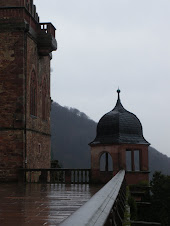
I don't have an independent memory of that first trip, but there are family pictures of me and my sister sitting on the ledge of the Heidelberg Schloss, the six hundred year old castle that sits up on the mountain overlooking the town and the Neckar River. Heidelberg has an Old Town, like most European cities, that sits along the river, and where you can find the tourists milling through expensive stores and novelty shops. But Heidelberg is, as it has been for the past century, a University town, and students have been milling around the town for hundreds of years.
I think that is the last time I visited Heidelberg, until Monday. I have been in Germany at least three times over the past few decades, but it wasn't until I was planning this most recent trip that I thought to include a detour to my birthplace. During the past four months (almost five!) I have been living in Europe, the subject of my birthplace has come up frequently with my French friends. For in France, as it is all over Europe, it is where you were born that dictates who you are, as opposed to the US, where it is what you do that is your defining feature. I am proud to say that I was born in Heidelberg, but embarrassed to say that I don't speak German. But I did pretty well over a few days of picking up enough words to be polite, at least. Learning languages becomes easier the more you learn...
I drove up to Heidelberg from Remshalden-Grunbach, where I was visiting my friend Uli (and staying in his aunt and uncle's hotel, Hotel Hirsch). It was raining that morning, but I took off anyway, determined not to spend the day hanging around the hotel. Uli helps out at the hotel, but mostly runs his own restaurant, Uli’s Hirschstüble, about 1 km from the hotel. The night before I left, Uli invited several of his friends who speak English, two of whom I first met over 25 years ago, to have dinner with me at his restaurant. I had visited Uli just twelve months previously, in December of 2007, so it was like old-home-week, catching up with Bertin, Tomas and Hans. It turned out that Tomas had been a student at the University of Heidelberg, but he did not give me many thoughts about what to do in the town. We were too busy dissecting the grade reports he had received of his eldest son, who is spending the year in Sioux Falls, South Dakota, attending the high school there.
It took me an hour and a half to reach Heidelberg, which is northwest of Remshalden. I found the train station easily (the Haptbahnhof), and the large tourist center there. I parked and walked inside, telling the receptionist that I was there to see the town. She handed me a map (just like they do in Nice, when you go to the Tourism office), told me which bus to take, and suggested a few things to do. It being Monday, like in most other places in Europe, many of the stores and museums were closed. But the castle was open, and that seemed like a good place to start. At the suggestion of the young woman, I drove to the castle and parked in a parking lot nearby, rather than take a bus and park downtown. Given the day and the weather and the time of year, it was no surprise that the parking garage I found was not full.
I walked out of the garage, and followed a man who was walking up a set of stairs in the direction of the castle. And indeed, the stairs took me to the entry of the castle. It looked almost deserted; the rain was falling still, and the one shop I passed had a sign that said it was closed for the day. But I found the ticket kiosk, and bought an entry ticket and headed for the schloss. Inside, I found the booth to buy a ticket for a guided tour in English, which was not to start for another forty-five minutes. The guard I spoke with thereafter suggested I take a look at the big wine cask in the bottom of the castle. I headed in that direction, and found the enormous cask, built into its own room, in the basement of the castle. During a certain period of time, it held the wine (both red and white mixed together, my tour guide later recounted) for the towns in the surrounding areas. It was where the soldiers and labourers would come for their daily allotment. Today, of course, it is a curiousity, and there is some good marketing, with the large room outside the cask room set up as a wine-tasting area, with tables for standing and sitting, and a cafe in the corner for those who want to sit and hang around for a while. Which is what I did, taking out my improvised lunch (apples, juice box, crackers), and catching up on some writing while I waited for the Tour.
About sixteen of us had gathered by 12:15 for the Tour. Our guide, a small but energetic German man wearing a beret, used fairly good English to recount the history of the Schloss, the building and the people who lived there. Components of the building were familiar to me, as one who has seen lots of castles on my travels, from Ireland to Austria to St. Petersburg, Russia. The kitchen (which we could not see directly) was built to feed 2000 people, there was a beautiful chapel, and we saw rooms with large porcelain heaters for the cold winter nights in Germany.
The tour took about an hour. Afterward, I took a walk around the gardens outside the castle, gardens which also overlook the Neckar River. I was freezing at that point, and had been debating the idea of going for a run. I had come up with the idea before I left that morning, and so had brought all my running clothes with me. If it had been pouring rain, I would not have run, but the rain had lessened, and the skies were opening up as I toured the garden walk. I knew a run would warm me up, and I decided to go for it. I went back to the parking garage, took my clothes out of the trunk, and changed inside my little Fiat. As I was heading out of the garage, I found a WC (toilet), and it was very warm inside - I thought, this is where I will change when I return!
I headed down the hill and through the old town, and then to the pedestrian bridge across the river. The wind was whipping as I ran across the bridge, and I held onto my Barnard cap as I ran. On the other side of the river, I headed west, toward another bridge, deciding I would do a loop. It looked like at least 3 miles, anyway. As I was getting close to the bridge ahead of me, I was stopped by a young German woman, who asked me for directions. She asked me about a street, which I didn't know, but she also asked about the Philosopher's Garden, which I told her was nearby, but I had not found the way to reach it. This conversation was a mix of German and English; already I was finding I could come up with some German words (or at least understand some of them) when necessary. Prompted by her question, I turned away from the river and headed down a street or two, eventually finding a sign that indicated the way up the hill to the Philosopher's Garden. It didn't take very long; I'm surprised how easily one can just stumble along things when one isn't really looking.
I headed up the hill, which took me past a University building and a number of students walking back to class (it was around 2 p.m. in the afternoon). I climbed higher and higher (huffing and puffing a bit), and was amused to see messages written in chalk (or paint) along the path (once I left the street), clearly intended for runners in a race at this height. Eventually I reached the Philosopher's garden, which overlooks the town from the opposite side of the river as the castle. There is a tradition of academics and philosopher's in the town, but I did not read up on this too much. There are plenty of places for you to do so; here's one useful site I found. I was happy to be up high, with a fantastic view of the valley and the Neckar river, in spite of the greyness of the day.
After heading back down the hill and back across the river, I ran through the university campus and back to my car. A good 40 minute run; a good sense of the town. I have a tradition, since I first starting traveling on my own back in 1983, of using a run as a way to explore a new place, and it has always enhanced my experience in a new place. And, by careful memorization of maps and street signs, a bit of caution, and using my fairly decent internal compass, I have never gotten lost (completely, anyway).
I changed back into my clothes in the WC I had found in the garage, drank the apple juice in my car, and headed out of town. My destination was the Hotel Rose, in one of the neighborhoods of Heidelberg. Before I had left Grunbach that morning, Uli had called his friend Beate, whose family runs the hotel. The two of them had been in hotel school together, but it had been a long time since he had seen her or talked to her. But he didn't hesitate to contact her when he knew I would be in Heidelberg. Also, his friend had married an American (stationed in Heidelberg), and Uli thought that the family would have a pretty good working knowledge of English (for my benefit). It turned out, after speaking to Beate's mom, that Beate would not be there that afternoon, but Uli gave me directions to go visit the hotel anyway.
So, after asking for directions, I found the Hotel Rose in Rorhbach. I entered the hotel and was directed to the woman sitting behind the registration desk. I told her I was Uli's friend, and after a moment, she brightened, and welcomed me into the dining room. She asked if I wanted anything, and I said coffee and perhaps...she volunteered, Cake! So over kuchen and caffe, I had a hour's conversation with Frau Fein. This conversation too was a mixture of English and German, but it was easy to understand her. We talked about the next day's inauguration, her visit to the US several years ago (including a personal backstage tour of the Met Opera by an Austrian-born Met tour guide who was so happy to have German speakers in her tour group), and the state of the economy in Heidelberg (of which the US Army and its personnel are a significant part). It was a lovely visit. As the afternoon darkened, I told her I needed to head home. She said, the Americans - always on the move! She told me to tell Uli that she would come visit his restaurant, but she also said that she and her husband rarely go anywhere. Ah, a very different mindset than my own!
The drive back was longer, through rain and heavy traffic as workers headed home. There were several accidents on the autobahn, and I was happy again that I don't commute to work (actually, I don't work at the moment, do I?). It was a brief visit to Heidelberg, but when I think of the town now, I won't think of that long-ago picture of me with pigtails sitting on the schloss wall, I will think of the river and its bridges, the old castle and its broad gardens, and the friendly German people I met there.
My Dad took our family on a trip overseas when I was 10 years old; we bought a VW Camper in Amsterdam, figured out how to put up a tent for 5 of us, and took off for Scandinavia, Germany and Switzerland. We visited exchange students and their families, whom we had housed during the previous several years, which added a personal component to all the cities we visited: Copenhagen, Stockholm, Stuttgart, and Geneva. Along the way in Germany, my parents made sure we stopped in Heidelberg, so I could see the city where I was born. At this point in my life, I wasn't busy filling out forms about where I had been born, so I think it was more my parents wanting me to see the place, rather than some curiousity of mine. I don't think my sister or brother ever asked to see the hospital where they were born in Greenwich, Connecticut.
I don't have an independent memory of that first trip, but there are family pictures of me and my sister sitting on the ledge of the Heidelberg Schloss, the six hundred year old castle that sits up on the mountain overlooking the town and the Neckar River. Heidelberg has an Old Town, like most European cities, that sits along the river, and where you can find the tourists milling through expensive stores and novelty shops. But Heidelberg is, as it has been for the past century, a University town, and students have been milling around the town for hundreds of years.
I think that is the last time I visited Heidelberg, until Monday. I have been in Germany at least three times over the past few decades, but it wasn't until I was planning this most recent trip that I thought to include a detour to my birthplace. During the past four months (almost five!) I have been living in Europe, the subject of my birthplace has come up frequently with my French friends. For in France, as it is all over Europe, it is where you were born that dictates who you are, as opposed to the US, where it is what you do that is your defining feature. I am proud to say that I was born in Heidelberg, but embarrassed to say that I don't speak German. But I did pretty well over a few days of picking up enough words to be polite, at least. Learning languages becomes easier the more you learn...
I drove up to Heidelberg from Remshalden-Grunbach, where I was visiting my friend Uli (and staying in his aunt and uncle's hotel, Hotel Hirsch). It was raining that morning, but I took off anyway, determined not to spend the day hanging around the hotel. Uli helps out at the hotel, but mostly runs his own restaurant, Uli’s Hirschstüble, about 1 km from the hotel. The night before I left, Uli invited several of his friends who speak English, two of whom I first met over 25 years ago, to have dinner with me at his restaurant. I had visited Uli just twelve months previously, in December of 2007, so it was like old-home-week, catching up with Bertin, Tomas and Hans. It turned out that Tomas had been a student at the University of Heidelberg, but he did not give me many thoughts about what to do in the town. We were too busy dissecting the grade reports he had received of his eldest son, who is spending the year in Sioux Falls, South Dakota, attending the high school there.
It took me an hour and a half to reach Heidelberg, which is northwest of Remshalden. I found the train station easily (the Haptbahnhof), and the large tourist center there. I parked and walked inside, telling the receptionist that I was there to see the town. She handed me a map (just like they do in Nice, when you go to the Tourism office), told me which bus to take, and suggested a few things to do. It being Monday, like in most other places in Europe, many of the stores and museums were closed. But the castle was open, and that seemed like a good place to start. At the suggestion of the young woman, I drove to the castle and parked in a parking lot nearby, rather than take a bus and park downtown. Given the day and the weather and the time of year, it was no surprise that the parking garage I found was not full.
I walked out of the garage, and followed a man who was walking up a set of stairs in the direction of the castle. And indeed, the stairs took me to the entry of the castle. It looked almost deserted; the rain was falling still, and the one shop I passed had a sign that said it was closed for the day. But I found the ticket kiosk, and bought an entry ticket and headed for the schloss. Inside, I found the booth to buy a ticket for a guided tour in English, which was not to start for another forty-five minutes. The guard I spoke with thereafter suggested I take a look at the big wine cask in the bottom of the castle. I headed in that direction, and found the enormous cask, built into its own room, in the basement of the castle. During a certain period of time, it held the wine (both red and white mixed together, my tour guide later recounted) for the towns in the surrounding areas. It was where the soldiers and labourers would come for their daily allotment. Today, of course, it is a curiousity, and there is some good marketing, with the large room outside the cask room set up as a wine-tasting area, with tables for standing and sitting, and a cafe in the corner for those who want to sit and hang around for a while. Which is what I did, taking out my improvised lunch (apples, juice box, crackers), and catching up on some writing while I waited for the Tour.
About sixteen of us had gathered by 12:15 for the Tour. Our guide, a small but energetic German man wearing a beret, used fairly good English to recount the history of the Schloss, the building and the people who lived there. Components of the building were familiar to me, as one who has seen lots of castles on my travels, from Ireland to Austria to St. Petersburg, Russia. The kitchen (which we could not see directly) was built to feed 2000 people, there was a beautiful chapel, and we saw rooms with large porcelain heaters for the cold winter nights in Germany.
The tour took about an hour. Afterward, I took a walk around the gardens outside the castle, gardens which also overlook the Neckar River. I was freezing at that point, and had been debating the idea of going for a run. I had come up with the idea before I left that morning, and so had brought all my running clothes with me. If it had been pouring rain, I would not have run, but the rain had lessened, and the skies were opening up as I toured the garden walk. I knew a run would warm me up, and I decided to go for it. I went back to the parking garage, took my clothes out of the trunk, and changed inside my little Fiat. As I was heading out of the garage, I found a WC (toilet), and it was very warm inside - I thought, this is where I will change when I return!
I headed down the hill and through the old town, and then to the pedestrian bridge across the river. The wind was whipping as I ran across the bridge, and I held onto my Barnard cap as I ran. On the other side of the river, I headed west, toward another bridge, deciding I would do a loop. It looked like at least 3 miles, anyway. As I was getting close to the bridge ahead of me, I was stopped by a young German woman, who asked me for directions. She asked me about a street, which I didn't know, but she also asked about the Philosopher's Garden, which I told her was nearby, but I had not found the way to reach it. This conversation was a mix of German and English; already I was finding I could come up with some German words (or at least understand some of them) when necessary. Prompted by her question, I turned away from the river and headed down a street or two, eventually finding a sign that indicated the way up the hill to the Philosopher's Garden. It didn't take very long; I'm surprised how easily one can just stumble along things when one isn't really looking.
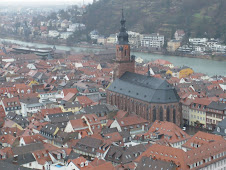
I headed up the hill, which took me past a University building and a number of students walking back to class (it was around 2 p.m. in the afternoon). I climbed higher and higher (huffing and puffing a bit), and was amused to see messages written in chalk (or paint) along the path (once I left the street), clearly intended for runners in a race at this height. Eventually I reached the Philosopher's garden, which overlooks the town from the opposite side of the river as the castle. There is a tradition of academics and philosopher's in the town, but I did not read up on this too much. There are plenty of places for you to do so; here's one useful site I found. I was happy to be up high, with a fantastic view of the valley and the Neckar river, in spite of the greyness of the day.
After heading back down the hill and back across the river, I ran through the university campus and back to my car. A good 40 minute run; a good sense of the town. I have a tradition, since I first starting traveling on my own back in 1983, of using a run as a way to explore a new place, and it has always enhanced my experience in a new place. And, by careful memorization of maps and street signs, a bit of caution, and using my fairly decent internal compass, I have never gotten lost (completely, anyway).
I changed back into my clothes in the WC I had found in the garage, drank the apple juice in my car, and headed out of town. My destination was the Hotel Rose, in one of the neighborhoods of Heidelberg. Before I had left Grunbach that morning, Uli had called his friend Beate, whose family runs the hotel. The two of them had been in hotel school together, but it had been a long time since he had seen her or talked to her. But he didn't hesitate to contact her when he knew I would be in Heidelberg. Also, his friend had married an American (stationed in Heidelberg), and Uli thought that the family would have a pretty good working knowledge of English (for my benefit). It turned out, after speaking to Beate's mom, that Beate would not be there that afternoon, but Uli gave me directions to go visit the hotel anyway.
So, after asking for directions, I found the Hotel Rose in Rorhbach. I entered the hotel and was directed to the woman sitting behind the registration desk. I told her I was Uli's friend, and after a moment, she brightened, and welcomed me into the dining room. She asked if I wanted anything, and I said coffee and perhaps...she volunteered, Cake! So over kuchen and caffe, I had a hour's conversation with Frau Fein. This conversation too was a mixture of English and German, but it was easy to understand her. We talked about the next day's inauguration, her visit to the US several years ago (including a personal backstage tour of the Met Opera by an Austrian-born Met tour guide who was so happy to have German speakers in her tour group), and the state of the economy in Heidelberg (of which the US Army and its personnel are a significant part). It was a lovely visit. As the afternoon darkened, I told her I needed to head home. She said, the Americans - always on the move! She told me to tell Uli that she would come visit his restaurant, but she also said that she and her husband rarely go anywhere. Ah, a very different mindset than my own!
The drive back was longer, through rain and heavy traffic as workers headed home. There were several accidents on the autobahn, and I was happy again that I don't commute to work (actually, I don't work at the moment, do I?). It was a brief visit to Heidelberg, but when I think of the town now, I won't think of that long-ago picture of me with pigtails sitting on the schloss wall, I will think of the river and its bridges, the old castle and its broad gardens, and the friendly German people I met there.
Tuesday, January 20, 2009
President Obama
President Obama. Gosh, doesn't that sound good! Such a very proud moment for Americans all over the world, to watch the inauguration this afternoon, and celebrate the moment - change is here, what exactly that will mean remains to be seen, but the ebullience is in the air.
Congratulations, Barack!
Congratulations, Barack!
Monday, January 12, 2009
Running in Nice
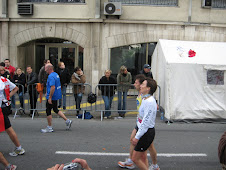
Nice has three big running events each year, the Prom Classic Nice 10-KM in January, the Nice International Semi-Marathon in April, and the Marathon des Alpes-Maritime in November. These are events that attract runners from all over France, Italy and parts of Europe, as well as the ever-present Kenyans. The races require closing the major avenue, the Promenade des Anglais, along the Mediterranean in Nice, causing havoc for drivers generally on those days, but the races are well supported by the city's residents and officials.
When I visited Nice last April, it was a beautiful Saturday morning when I was walking along the Promenade and saw the Runners' Expo on the Espace Jacques Cotta (a large park in the city center). I thought it would be great to join in the race the next day, and so I attempted to sign up for the race. But I was thwarted in my attempt by the need to produce a medical certificate attesting to my fitness for the competitive race. That was not a piece of paper I carried with me on my trips to Europe! Not to be kept from experiencing the racing community in Nice, the next day I ran down to the Promenade from my friend's apartment and joined the race as a "bandit," a runner without a number. Trying to disguise the fact that I was an illegitimate participant, I ran in the middle of the pack through the streets of Nice, rather than my traditional position closer to the front of the pack. The race that day was a great introduction to the city.
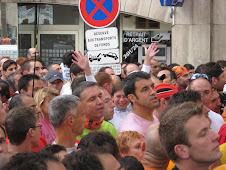
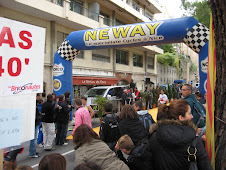
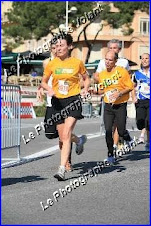
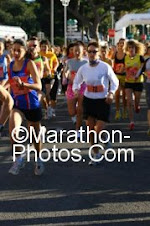
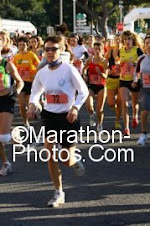
Yesterday I participated as an "official" participant in the Prom Classic 10Km, also run along the Promenade des Anglais. This time I was not only a registered racer (having acquired my certificat medical from my new doctor in Nice), but I was given a bib numbered 72, which meant that I was going to run under 43 minutes for the race, and therefore was among the "elite" women registered for the race. The ladies with numbers 1-100 had a special roped off section at the starting line - I did not have to elbow my way to the front of the pack, as is typical. Although many races try and assign runners to the starting line by the pace they will run during the race, this effort relies on the honesty and attention of the runners, and there are plenty of folks who are just competitive enough (even if not fast) that they want to start at the front and inevitably some folks who are just clueless (often seen wearing earphones and carrying an iPod for their "run") and join the starting line wherever they end up - sometimes in the midst of very fast runners.
This race also featured a perk for the ladies: a start time 5 minutes ahead of the men's start. Turns out this was a publicity coup for the organizers: the first man and first woman raced across the finish line together - a huge photo op! What it meant for the rest of us was that the top ladies got to start without fighting through the guys, and it was a very pleasant start, I must say. I got into my groove pretty quickly, and it wasn't until the 5km mark that the top men caught up with me. From then on, however, there were LOTS of guys passing me, a very new sensation; during the second half of a race I am usually the one passing people.
The day was beautiful and sunny, chilly but not cold (around 50 degrees), and I wore my sunglasses, as we were running along the sea for the entire race - out and back, with the turnaround at 5km. It was a familiar run for me, as readers of this blog will know, and I used landmarks to help keep me motivated along the way. But it was pretty windy, and I was glad I was wearing my long-sleeve Barnard t-shirt (but the shorts were a good idea), and while I was running with ladies during the first half of the race, during the second half there were long stretches when I was running by myself into the wind, and cursing the fact that there was no one in front of me to break the wind!
At my last 10km race in Grasse, I had felt that I hadn't pushed myself during the first half of the race. Remembering that, yesterday I kept my foot on the pedal throughout the race (which means for me, labored breathing, but not gasping for breath). I kept that pace going through the first half, and then tried to keep it up during the second 5km. It was difficult, with the wind, and with my lack of conditioning - two weeks off during the holidays had apparently had an effect. I kept pumping my legs, telling myself that the reason I lifted weights was for just this purpose, to keep my legs pumping at the end of a race! I started feeling that fuzzy feeling in my head in the last kilometer, which means I was pushing it, and overheated (and if it had started earlier, I would have backed off my pace a little; I'm all too familiar with heat exhaustion), but I pushed on as best as I could to the finish.
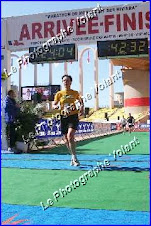
As I approached the finish line, the first clock I saw showed a time of 37 minutes. I said to myself, No Way! And then quickly saw to the left of the clock, another clock, showing 42 minutes. Oh, yeah, that clock on the right was the time for the guys! The clock was already at 42:40 - I really wanted to finish under 43, so I hustled in over the finish line: 42:56. Under 43. I was exhausted. But sort of bummed; my last 10km time in November had been 42:12, and I was secretly hoping to match or improve upon that. But given my training, that hope was pretty unrealistic. So, positive attitude: happy with the day's results.
You can see, under "resultats," my stats for the race at http://www.promclassic.com/. I was 22nd in my age group, ladies 40-49. Given that this was the second largest 10km in France (5000 runners registered), I have to be happy with that. But, training continues! April is just around the corner.
When I visited Nice last April, it was a beautiful Saturday morning when I was walking along the Promenade and saw the Runners' Expo on the Espace Jacques Cotta (a large park in the city center). I thought it would be great to join in the race the next day, and so I attempted to sign up for the race. But I was thwarted in my attempt by the need to produce a medical certificate attesting to my fitness for the competitive race. That was not a piece of paper I carried with me on my trips to Europe! Not to be kept from experiencing the racing community in Nice, the next day I ran down to the Promenade from my friend's apartment and joined the race as a "bandit," a runner without a number. Trying to disguise the fact that I was an illegitimate participant, I ran in the middle of the pack through the streets of Nice, rather than my traditional position closer to the front of the pack. The race that day was a great introduction to the city.
Yesterday I participated as an "official" participant in the Prom Classic 10Km, also run along the Promenade des Anglais. This time I was not only a registered racer (having acquired my certificat medical from my new doctor in Nice), but I was given a bib numbered 72, which meant that I was going to run under 43 minutes for the race, and therefore was among the "elite" women registered for the race. The ladies with numbers 1-100 had a special roped off section at the starting line - I did not have to elbow my way to the front of the pack, as is typical. Although many races try and assign runners to the starting line by the pace they will run during the race, this effort relies on the honesty and attention of the runners, and there are plenty of folks who are just competitive enough (even if not fast) that they want to start at the front and inevitably some folks who are just clueless (often seen wearing earphones and carrying an iPod for their "run") and join the starting line wherever they end up - sometimes in the midst of very fast runners.
This race also featured a perk for the ladies: a start time 5 minutes ahead of the men's start. Turns out this was a publicity coup for the organizers: the first man and first woman raced across the finish line together - a huge photo op! What it meant for the rest of us was that the top ladies got to start without fighting through the guys, and it was a very pleasant start, I must say. I got into my groove pretty quickly, and it wasn't until the 5km mark that the top men caught up with me. From then on, however, there were LOTS of guys passing me, a very new sensation; during the second half of a race I am usually the one passing people.
The day was beautiful and sunny, chilly but not cold (around 50 degrees), and I wore my sunglasses, as we were running along the sea for the entire race - out and back, with the turnaround at 5km. It was a familiar run for me, as readers of this blog will know, and I used landmarks to help keep me motivated along the way. But it was pretty windy, and I was glad I was wearing my long-sleeve Barnard t-shirt (but the shorts were a good idea), and while I was running with ladies during the first half of the race, during the second half there were long stretches when I was running by myself into the wind, and cursing the fact that there was no one in front of me to break the wind!
At my last 10km race in Grasse, I had felt that I hadn't pushed myself during the first half of the race. Remembering that, yesterday I kept my foot on the pedal throughout the race (which means for me, labored breathing, but not gasping for breath). I kept that pace going through the first half, and then tried to keep it up during the second 5km. It was difficult, with the wind, and with my lack of conditioning - two weeks off during the holidays had apparently had an effect. I kept pumping my legs, telling myself that the reason I lifted weights was for just this purpose, to keep my legs pumping at the end of a race! I started feeling that fuzzy feeling in my head in the last kilometer, which means I was pushing it, and overheated (and if it had started earlier, I would have backed off my pace a little; I'm all too familiar with heat exhaustion), but I pushed on as best as I could to the finish.
As I approached the finish line, the first clock I saw showed a time of 37 minutes. I said to myself, No Way! And then quickly saw to the left of the clock, another clock, showing 42 minutes. Oh, yeah, that clock on the right was the time for the guys! The clock was already at 42:40 - I really wanted to finish under 43, so I hustled in over the finish line: 42:56. Under 43. I was exhausted. But sort of bummed; my last 10km time in November had been 42:12, and I was secretly hoping to match or improve upon that. But given my training, that hope was pretty unrealistic. So, positive attitude: happy with the day's results.
You can see, under "resultats," my stats for the race at http://www.promclassic.com/. I was 22nd in my age group, ladies 40-49. Given that this was the second largest 10km in France (5000 runners registered), I have to be happy with that. But, training continues! April is just around the corner.
French Cultural Christmas Traditions
My friend Joan, who succeed me as editor of the newsletter at my Washington, DC church (www.westernpresbyterian.org.), asked me to write up a submission for this month's edition on the French traditions of Twelfth Night. Below is what I sent her:
Twelfth Night
Twelfth Night in France is celebrated on the first Sunday (after the first Saturday) in January. Families and friends gather to share the “galette du roi,” the King’s Cake, in which a tiny figurine, a fève (literally meaning a bean, which is what they put in galettes long ago) has been baked. The person who finds the fève is declared the king (le roi) or the queen (la reine) and gets to wear the paper crown that comes with the galette.
Provençal Santons
Another tradition in the south of France is the display of manger scenes with santons. Santons, from the Provençal "santoùon,” or little saints, are clay or wooden figurines that depict the people, traditional trades, activities and costumes of Provence. Santons derived from the idea of the Provençal inhabitants on their way to the Nativity with their humble, local offerings. Lucéram, an ancient perched village located about twelve miles north of Nice, is where I first saw this tradition come to life: in Lucéram the inhabitants display several hundred different manger scenes made with the santons throughout the town, in every nook and cranny, from window ledges to tiny niches in the walls to large building basements. I walked the circuit of the town with a group late one night, under a full moon, which made for a special Christmas memory.
Protestant Traditions in France
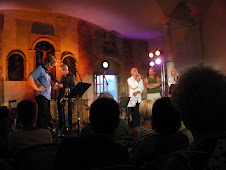
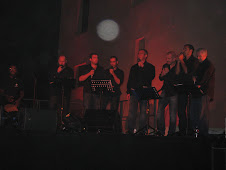
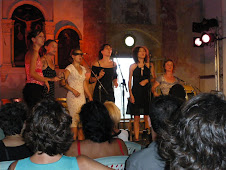
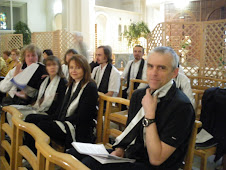
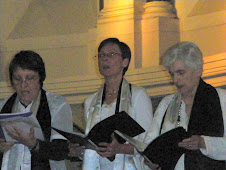
It was comforting to find familiar Christian Christmas traditions in the French Protestant church I attend in Nice, the Église Réformée. On the third Sunday in Advent, I felt right at home: during the service the children of the church acted out the Christ story (older children reading their parts, younger children in costumes dressed as angels). Also that morning I performed, along with 11 other church members in our small Choeur Gospel (Gospel Choir), familiar songs, including “Go Tell It On the Mountain” (in English) and “Lo, How A Rose E’re Blooming” (in German), as well as two other traditional French carols.
* * *
Having written about the galette du rois, I felt like I had to experience this French tradition. So last Saturday, I went to my local Artisan Patisserie (every time I walk by it, I stare in its windows, everything looks good), and bought a small fruit galette. As the woman wrapped up my cake, she slipped in the paper crown, the prize for the person who found the prize in the cake. Priscilla and I shared the cake (less like cake than a soft brioche) that evening, with Priscilla recommending we eat the whole thing, to make sure we found the prize. But I found the prize, a small plastic cat, as I cut my first piece, and I put on the crown. The crown was decorated with symbols of New Year wishes, including the elephant, the symbol for long life, and the four-leafed clover, the symbol for good luck. The Chinese believe the cat is imbued with magical powers, and is the symbol for riches and prosperity. I'll take that wish!
Twelfth Night
Twelfth Night in France is celebrated on the first Sunday (after the first Saturday) in January. Families and friends gather to share the “galette du roi,” the King’s Cake, in which a tiny figurine, a fève (literally meaning a bean, which is what they put in galettes long ago) has been baked. The person who finds the fève is declared the king (le roi) or the queen (la reine) and gets to wear the paper crown that comes with the galette.
Provençal Santons
Another tradition in the south of France is the display of manger scenes with santons. Santons, from the Provençal "santoùon,” or little saints, are clay or wooden figurines that depict the people, traditional trades, activities and costumes of Provence. Santons derived from the idea of the Provençal inhabitants on their way to the Nativity with their humble, local offerings. Lucéram, an ancient perched village located about twelve miles north of Nice, is where I first saw this tradition come to life: in Lucéram the inhabitants display several hundred different manger scenes made with the santons throughout the town, in every nook and cranny, from window ledges to tiny niches in the walls to large building basements. I walked the circuit of the town with a group late one night, under a full moon, which made for a special Christmas memory.
Protestant Traditions in France
It was comforting to find familiar Christian Christmas traditions in the French Protestant church I attend in Nice, the Église Réformée. On the third Sunday in Advent, I felt right at home: during the service the children of the church acted out the Christ story (older children reading their parts, younger children in costumes dressed as angels). Also that morning I performed, along with 11 other church members in our small Choeur Gospel (Gospel Choir), familiar songs, including “Go Tell It On the Mountain” (in English) and “Lo, How A Rose E’re Blooming” (in German), as well as two other traditional French carols.
* * *
Having written about the galette du rois, I felt like I had to experience this French tradition. So last Saturday, I went to my local Artisan Patisserie (every time I walk by it, I stare in its windows, everything looks good), and bought a small fruit galette. As the woman wrapped up my cake, she slipped in the paper crown, the prize for the person who found the prize in the cake. Priscilla and I shared the cake (less like cake than a soft brioche) that evening, with Priscilla recommending we eat the whole thing, to make sure we found the prize. But I found the prize, a small plastic cat, as I cut my first piece, and I put on the crown. The crown was decorated with symbols of New Year wishes, including the elephant, the symbol for long life, and the four-leafed clover, the symbol for good luck. The Chinese believe the cat is imbued with magical powers, and is the symbol for riches and prosperity. I'll take that wish!
Subscribe to:
Posts (Atom)













+of+IMG_0522.JPG)
+of+IMG_0505.JPG)
+of+IMG_0495.JPG)